GIVEAWAY: Win 1 of 5 copies of Guilt-Free Bottle Feeding by Madeleine Morris & Dr Sasha Howard (CD: 31/10/2014)

Posted on

Capture

I’ve written dozens of posts now about breastfeeding. Although I’d urge mum (that can!) to try and breastfeed, I know better than most that it isn’t easy. I lasted 6 weeks with both of my babies and I’m incredibly proud of myself for lasting that long.

With both children I was hit by crippling depression and anxiety. Although I believe every mother has the capacity to breastfeed, that doesn’t necessarily mean it’s the best thing for her or her baby. My mental health really suffered as a result of breastfeeding and yet I put myself under incredible pressure to continue. Panic attacks ensued and I wound up being hospitalised several times. As a result I wasn’t the best mother I could be, and I didn’t enjoy those first precious weeks with Dexter or Heidi.

But Breast is Best… right?

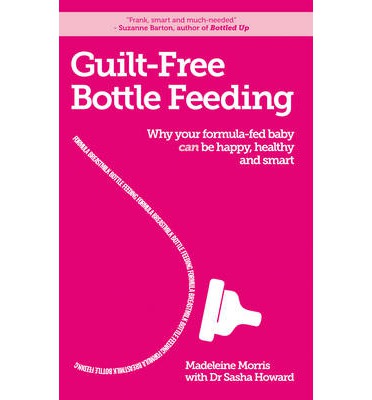
Maybe not. Madeleine Morris and Dr Sasha Howard have now launched a myth-busting book that shows women they are not bad mothers if they can’t or don’t want to breastfeed; Guilt-Free Bottle Feeding - why your formula-fed baby can be happy, healthy and smart.

036

This isn’t an anti-breastfeeding book, it’s an anti-guilt book

Unfortunately, in the quest to promote breastfeeding, formula and mothers who formula-feed or mix-feed have become demonised… We have all come to believe that ‘good mothers breastfeed, bad mothers bottle feed’. This is not only simply wrong, this ill-founded belief is damaging mothers, and their relationships with their babies, in what should be one of the happiest times of their lives. Madeleine Morris

9781908281777
Half of all British babies will have a bottle of formula before they are a week old and their mothers feel guilty. They feel guilty because every single book, poster and midwife tells them that breastfeeding is the single most important thing they can do for their babies.
.
But for some families, breast isn’t best. Some mums don’t produce enough milk, some have post-natal depression, others are juggling two kids already, or need to go back to work, and some mums simply don’t like breastfeeding. Are they bad mothers? No! But they believe themselves to be.
.
Guilt-Free Bottle Feeding, written by award winning former BBC presenter Madeleine Morris and paediatrician Dr Sasha Howard resets the conversation around infant feeding, revealing how the benefits of breastfeeding have been oversold to British parents, and showing guilt-wracked new mothers they have not failed their babies by giving them formula.
.
With a thorough, yet easy-to-understand analysis of science, parenting sociology and the modern media, Guilt-Free Bottle Feeding provides a balanced, much- needed and long-overdue alternative view to the simplistic message that ‘breast is best’. This practical book proves that despite the huge pressure women feel to breastfeed, it possible to raise perfectly happy, healthy and smart bottle-fed and mixed-fed children.

Breast milk is wonderful stuff… but sometimes breastfeeding doesn’t work out, for a huge number of complex physical and social reasons. We need to show mums they are not failures for giving their babies a bottle. Dr Sasha Howard

Guilt-Free Bottle Feeding:
  • Examines over a hundred original medical journal articles to show the benefits of breastfeeding in the developed world are not as clear cut as women are told
  • Looks at emerging evidence that the immense pressure to breastfeed is now a contributing factor to post-natal depression
  • Shows how sloppy science reporting, ill-informed websites and celebrity culture unfairly demonise bottle feeding, leaving mothers feeling like failures
  • Points out the double standards of a medical system which relentlessly pressures mothers to breastfeed, but doesn’t provide them with the support they need
  • Calls for an individually tailored ‘feeding plan’, to give mothers a realistic feeding goal rather than the blanket 6-month exclusive breastfeeding target, which 98% of UK mums fail to meet
  • Calls for a mother’s physical and mental needs to be valued in the feeding relationship
  • Reveals the ‘X-Factor’ of breastfeeding research, and why we may never know the differences between breastfed and formula-fed babies
  • Gives a large, detailed guide to choosing a formula, safe bottle preparation and how to bottle feed for maximum health and bonding – information which is shamefully lacking in the NHS.
Told with humour and personal experience yet grounded in years of fastidious research, Guilt-Free Bottle Feeding is a much needed real-world counterpoint to the almost religious promotion of breastfeeding which now dominates medical and parenting discourse.
.
As mothers who both breast- and bottle-fed their babies (they met at their NCT class), and decorated professionals in their fields of journalism and paediatrics, Madeleine Morris and Dr Sasha Howard are uniquely placed to provide evidence-based reassurance to mothers they are not failures if they don’t exclusively breastfeed.
.
Guilt-Free Bottle Feeding: Why your formula-fed baby can be happy, healthy and smart By Madeleine Morris & Dr Sasha Howard is available on Amazon for £7.59 (ISBN: 9781908281777), or in e-book format for £6.99 (ISBN: 9781908281784)
.

*** GIVEAWAY ***

I haven’t read this book yet, but a copy is on its way to me. As someone who staunchly believes that breast isn’t always best and advocates pro-choice when it come to feeding your baby, I’m all for it.

If you’re currently bottlefeeding, pregnant, or just interested in the findings, you can win 1 of 5 copies right here. Just enter via the rafflecopter below.
a Rafflecopter giveaway

T&C’s – a.k.a – the boring bit!
    • Only 1 option is mandatory (leave me a comment) – the rest only improve your chances of winning so just complete as many as you feel like
    • UK entrants only – you must be over 18 too (sorry)
    • The winners will be contacted by email and must respond within 1 week of having been emailed (I’ll try all known avenues to contact them) or a new winner will be drawn
    • When the giveaway is closed, Rafflecopter will select the winner completely at random
    • The winners name will be published on this site

Win competitions at ThePrizeFinder.com


Midwives and Breastfeeding Sensitivity Training

Posted on

Visiting a friend (and first-time mummy) a few weeks ago I was shocked to find her in tears. She’d been really struggling with breastfeeding and worried that her baby appeared to be losing weight. Although she followed up with her midwife and was reassured that baby was fine, she clearly wasn’t. She was exhausted. When I delicately broached the subject of combination feeding or perhaps expressing so her partner could assist her, she got even more distressed. Like most new mums who are feeding on-demand, expressing was really difficult and not yielding enough. Her partner was also very insistent that she carry on with breastfeeding.

When I left her house that day I couldn’t stop mulling over her dilemma. She was clearly crying out for help but running into a brick wall. She didn’t have any options. Very emotional and tired she wasn’t able to make the decision to discontinue breastfeeding on her own, and wasn’t receiving the support she needed to do so from her partner. I didn’t want to advise her against something that her partner seemed so passionate about as this would be tantamount to meddling in her relationship. Although it seems so strange to me that her other half would be so obstinate, it’s not really his fault. When I began to think about my own experience of breastfeeding with Dexter, I can absolutely see where his anxiety stems from - their midwife.

breastfeeding

Craig came to most of my ante-natal appointments when I was pregnant with Dexter. As he is self-employed, this often meant he lost money but it was important to him to learn as much as he could before D Day. The obligatory breastfeeding class was one exception. He was swamped with work and it didn’t seem relevant to him. It turns out I was the only woman who attended alone - the room was full of couples.

For me, the class was pretty pointless. We covered the benefits of breastfeeding (which were all helpfully contained within leaflets we were sent home with anyway) and were assured our midwives would be there to help and support us. I learnt nothing that I couldn’t have read for myself and was fed up that I’d travelled on three buses to get to the class when I was heavily pregnant.

It’s not that I don’t think breastfeeding is important. We all know the health advantages for baby, the financial advantages, the bonding opportunity… the fact it could help you shift that pesky baby weight… I will definitely try again with this new baby. I was however a little surprised that the breastfeeding expert leading the class didn’t even mention bottle feeding. At the very least I think she should have touched upon the fact that it is perfectly acceptable and there are some instances where it is the only option (for mothers with premature babies etc).

I remember getting home and telling Craig the bare bones, thrusting the leaflet in his hands whilst he was engrossed Manchester Utd on the telly, and casually mentioning that I wanted to give it a try. Although he’s the most attentive father in the entire world, I very much doubt he was bothered what I was blathering on about that day. As long as Dexter was born healthy, and I was safely through the birth and coping in my new role as mummy, Craig wasn’t particularly bothered how he was fed. He just wanted Dexter and I to be safe and well.

Dexter was born via emergency c-section at 38 weeks. He was by no means premature, but it did come as a huge shock to us both. I was just one day into my maternity leave when my placenta abrupted and I bled out. It was around midnight and when the ambulance arrived both of us were fearing the worst. On reflection, we’d had a completely stress-free pregnancy up until that point and we needn’t have worried. We were at the hospital within 30 minutes of that bleed and in the best possible place to get baby out - I think we were just mentally unprepared to face that prospect at that moment.

When Dexter was in our arms we were overwhelmed - like any new parent would be. I was groggy from a c-section and both of us were exhausted. I honestly don’t remember anyone asking me whether we intended to breastfeed but it was pretty clear from the off that was what the midwives wanted. At every opportunity (whether Dexter was asleep or not) they would be plucking him out of his hospital bassinet and laying him on my chest. Despite the fact my milk hadn’t fully come through yet, Dexter was encouraged to find my breast and suck - and to my delight, he seemed happy to latch on. Within just a few hours however, we were having issues. Although Dexter was suckling and engaged, he wasn’t receiving any milk.

I sought a midwife and asked to be bought some formula. I might aswell have spat on her and threatened to stab her - her face was positively thunderous.

Instead she grabbed my breasts and pummelled them. She insisted that massage would bring my milk through and I shouldn’t give up so easily. Thrusting a pipette in Craig’s hands, she told him to catch any dribbles and demonstrated how he should be massaging my breasts. She then flounced off and said she’d be back in an hour. An hour later Craig and I hadn’t managed a single drop, I was sore from all the squeezing and Dexter was pretty distressed. Once again, I insisted on formula.

Finally she relented and agreed to go to the storeroom for us (I think it was due to the fact that Dexter was disturbing the entire ward) but even this was met with some serious attitude. She asked me which brand I wanted and (naturally) Craig and I didn’t quite know what to say. Our response was something along the lines of “What would you suggest?” and we were quickly enlightened that she was unable to suggest a recommend a brand for legal purposes. I completely understand that a midwife can’t be seen to endorse a specific product but she wouldn’t even tell us the brands they stocked. I can honestly say I was royally pissed off that we had to google “UK Baby Milk” and pick the first one that came up before our son could be placated.

A few hours later I asked to be discharged from hospital. I understand this is pretty atypical for a woman who has had a caesarean but I was practically climbing the wall at this point. I have a fear of hospitals and was pretty fed up. The same bolshy midwife came over and informed me that she wouldn’t sign off the discharge papers until she had witnessed two successful latches from Dexter. If I could get him to feed, I was to press my buzzer and send for her. For some strange reason we agreed and followed her instructions to the letter - we were home just a few hours later.

When I look back on it - I’m absolutely FURIOUS. I was a 30-year-old woman with a 40-year-old partner - I didn’t expect to be bribed or belittled. I asked to be sent home, I was medically fine to be sent home, I should have told her to go to hell. Despite playing her game, we still stopped at a 24-hour Tescos on the way home to buy formula. The most important thing to us was that Dex was fed. Of course I was going to put every effort into breastfeeding, but not at the expense of my child’s health. If he needed milk, he’d get it - from me or from a carton.

Turns out it wasn’t needed. Much to the midwife’s surprise, we stuck with it and Dex was exclusively breastfeed for the few 5 weeks. The process was only halted by Dex’s hospitalisation with Strep B. I was unable to express a sufficient amount so Dex had to switch to the bottle. There was not one moment’s deliberation; I wasn’t disappointed at all.

Dexter on the bottle

Dexter on the bottle

Bottle feeding certainly had its advantages. For one, both mum and dad can feed baby and share responsibility for the nightfeeds. There was also no anxiety over Dex was eating enough - we followed the instructions and knew he was getting the feeds he needed. Do I feel guilty, upset or sad? Not in the slightest.

With this new baby, I hope to breastfeed longer. Why? Not because of the health benefits to baby I can assure you! I know my baby will be as happy on formula as he is my breast and I won’t be swayed by the dozens of utterly ridiculous studies that exist out there. I don’t for one second believe my baby will be more intelligent, more handsome, more happy as result of receiving my breast milk. I just want to do it for me.

And will Craig support my decision? Yes.

And would he feel differently had he been to that breastfeeding class with me? Who knows

I seriously doubt it. Craig has quite a rational brain and if he saw that I was emotionally and physically struggling with breastfeeding, he would have immediately thought of me first. Having said that, if Craig wasn’t the man he is, then the insistence of the midwife combined with that completely singually focused class, then I can understand why some men can be inflexible.

My response?

I have my own theory on why the NHS are pushing breastfeeding so fervently. I suspect the midwives are set targets by the government or hospital trusts to send as many new mums home as breastfeeders as possible. I have absolutely no proof of this but can say that every single feed Dexter took from my breast in those first few hours were religiously documented by the midwife.

I think this is utterly ridiculous. We’re not ‘targets to be met’ - I’m a responsible adult who wants the best for my child and I won’t be dictated to by a midwife ever again. I completely agree that as many people as possible should be encouraged to breastfeed, BUT believe this should be done with sensitivity. It is simply not at all fair to put a first-time mum under such pressure. It would be far better for the midwife to properly outline a mother’s options and give her the choice. If we specifically state that we want to breastfeed then please help us and encourage us not to give up, but DON’T bully us into it. If our next midwife does this to us, she will be reported.

This isn’t the first time I’ve had a whinge about breastfeeding - you can reading more here


What made me spit out my cornflakes this morning? #KBBF13

Posted on

No it wasn’t that I accidentally sat on the remote control and discovered my mum and dad having a row in Jeremy Kyle’s green room. It was the utterly ridiculous study that was somehow granted 5 minutes worth of sofa-time on BBC Breakfast this morning; a study that has apparently revealed that breastfed babies have a better chance of upward class mobility in later life.

Before I get verbally battered by breastfeeder’s, it’s worth pointing out that I’m pro-choice. I breastfed Dexter for almost 2 months before Strep B landed him in hospital, and stress meant I could not express enough to exclusively sustain him. Had Dexter not experienced these problems, I like to think I would have carried on. Certainly with baby 2 I’ll be whipping out the 36GG’s and saving on extortionate formula prices. As studies have suggested this can be a way of losing the baby weight, I’m fully onboard! But this ridiculous segment this morning got on my nerves.

113

I’ve written before about ethical health reporting and spurious research. It’s a pet hate of mine to turn on my TV (especially to BBC) to discover so-called health experts making outlandish claims and making a mockery out of serious debates. The sound-byte culture we live in means that sexy health-related headlines end up getting precious air-time, and it doesn’t matter if they are supported by empirical evidence or not. If it sounds shocking and supports a wider NHS agenda, let’s run with it.

It doesn’t matter that I haven’t graduated from Cambridge with a degree in breastfeeding, I’m quite prepared to say that this report is utter nonsense.

I was pleased to see that Bill Turnbull and Louise Minchin greeted this woman (Amanda Sacker, University College London) and her shoddy report with just as much scepticism as I did. Louise’s questions were loaded with apprehension and she asked the same questions I would have asked (with just a little more restraint than I’d have mustered) - “What about mother’s who express?“, “Or mother’s that have breastfed one, yet not another child?“. It was these arguments that quickly saw the ‘expert’ backtrack and insist that other factors would balance out the discrepancy. If this doesn’t reveal just how woefully shallow her argument is, I don’t know what does!

1D788A3A49626E988A20221BA0BD4A7F

It seems to me (and hopefully any other rational human being) that children who grow into successful adults and manage to improve upon the social standing of their parents, are a product of several different factors. Baseline class would of course be one; it surely depends on which ‘class’ (sigh) your parents fall into, that will determine how minor or huge the next step up will be. Location, the strength of the family unit, family finances, childhood experiences… there are just so many factors that come into play beyond-the-breast.

The ‘expert’ explained her study in scant detail as though even she was embarrassed and wanted to skirt over its lack of credibility. She stated that she followed two groups of women - group 1 exclusively breastfed their babies, group 2 did not. No mention was made of the size and location of these groups*, and no statistical evidence was proffered to support the claim. The Daily Telegraph also appears to have lent the unconvincing Amanda Sacker some credence, but even these stats fail to convince me there is anything worth investigating further.

The research paper, published in the British Medical Journal, uses information from long-running studies of the lives of two groups of around 17,000 people: one set born in a single week in 1958 and another born during a single week in 1970.

They were each assigned to one of four nominal social classes based on their father’s job when they were 10 or 11 – ranging from “unskilled” to “professional”. They were then reassigned based on their own line of work when they were 33 or 34.

The study, the first study of its kind, found that overall those who had been breastfed were 24 per cent more likely to move up a class between childhood and their early 30s.

Some also dropped to a “lower” class but those who were breastfed were 20 per cent less likely to have done so than those who weren’t. DAILY TELEGRAPH

It amazes me that this supposedly well-qualified and intelligent woman (who is no doubt funded by Government and our cash-strapped NHS) is prepared to perpetuate such a weak claim. It cheapens a very valid argument for breastfeeding, and heaps new anxiety on bottlefeeders everywhere. Let’s try to stick to the facts in future please BBC.

To see more reaction, head on over to BBC Breakfast’s Facebook page.

robert-winston-02

* Robert Winston went on to explain in a later segment that some 34,000 women were involved. Curiously he backs and welcomes the study and refers to the habits of rodents (exclusively breastfed animals) to prove that breastfeeding helps with cognitive ability and brain development. Although I can’t for the life of me see why rodents are significant in this assertion, I don’t disagree that breastfeeding offers a wealth of health benefits. Quite why any of these would have any influence at all on a child’s sociability and class is beyond me.

Related Posts Plugin for WordPress, Blogger...