GIVEAWAY: Win 1 of 5 copies of Guilt-Free Bottle Feeding by Madeleine Morris & Dr Sasha Howard (CD: 31/10/2014)

Posted on

Capture

I’ve written dozens of posts now about breastfeeding. Although I’d urge mum (that can!) to try and breastfeed, I know better than most that it isn’t easy. I lasted 6 weeks with both of my babies and I’m incredibly proud of myself for lasting that long.

With both children I was hit by crippling depression and anxiety. Although I believe every mother has the capacity to breastfeed, that doesn’t necessarily mean it’s the best thing for her or her baby. My mental health really suffered as a result of breastfeeding and yet I put myself under incredible pressure to continue. Panic attacks ensued and I wound up being hospitalised several times. As a result I wasn’t the best mother I could be, and I didn’t enjoy those first precious weeks with Dexter or Heidi.

But Breast is Best… right?

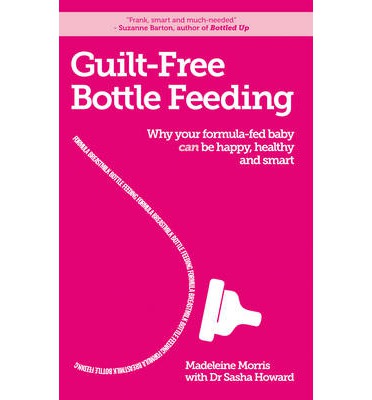
Maybe not. Madeleine Morris and Dr Sasha Howard have now launched a myth-busting book that shows women they are not bad mothers if they can’t or don’t want to breastfeed; Guilt-Free Bottle Feeding - why your formula-fed baby can be happy, healthy and smart.
036

This isn’t an anti-breastfeeding book, it’s an anti-guilt book

Unfortunately, in the quest to promote breastfeeding, formula and mothers who formula-feed or mix-feed have become demonised… We have all come to believe that ‘good mothers breastfeed, bad mothers bottle feed’. This is not only simply wrong, this ill-founded belief is damaging mothers, and their relationships with their babies, in what should be one of the happiest times of their lives. Madeleine Morris
9781908281777
Half of all British babies will have a bottle of formula before they are a week old and their mothers feel guilty. They feel guilty because every single book, poster and midwife tells them that breastfeeding is the single most important thing they can do for their babies.
.
But for some families, breast isn’t best. Some mums don’t produce enough milk, some have post-natal depression, others are juggling two kids already, or need to go back to work, and some mums simply don’t like breastfeeding. Are they bad mothers? No! But they believe themselves to be.
.
Guilt-Free Bottle Feeding, written by award winning former BBC presenter Madeleine Morris and paediatrician Dr Sasha Howard resets the conversation around infant feeding, revealing how the benefits of breastfeeding have been oversold to British parents, and showing guilt-wracked new mothers they have not failed their babies by giving them formula.
.
With a thorough, yet easy-to-understand analysis of science, parenting sociology and the modern media, Guilt-Free Bottle Feeding provides a balanced, much- needed and long-overdue alternative view to the simplistic message that ‘breast is best’. This practical book proves that despite the huge pressure women feel to breastfeed, it possible to raise perfectly happy, healthy and smart bottle-fed and mixed-fed children.

Breast milk is wonderful stuff… but sometimes breastfeeding doesn’t work out, for a huge number of complex physical and social reasons. We need to show mums they are not failures for giving their babies a bottle. Dr Sasha Howard

Guilt-Free Bottle Feeding:
  • Examines over a hundred original medical journal articles to show the benefits of breastfeeding in the developed world are not as clear cut as women are told
  • Looks at emerging evidence that the immense pressure to breastfeed is now a contributing factor to post-natal depression
  • Shows how sloppy science reporting, ill-informed websites and celebrity culture unfairly demonise bottle feeding, leaving mothers feeling like failures
  • Points out the double standards of a medical system which relentlessly pressures mothers to breastfeed, but doesn’t provide them with the support they need
  • Calls for an individually tailored ‘feeding plan’, to give mothers a realistic feeding goal rather than the blanket 6-month exclusive breastfeeding target, which 98% of UK mums fail to meet
  • Calls for a mother’s physical and mental needs to be valued in the feeding relationship
  • Reveals the ‘X-Factor’ of breastfeeding research, and why we may never know the differences between breastfed and formula-fed babies
  • Gives a large, detailed guide to choosing a formula, safe bottle preparation and how to bottle feed for maximum health and bonding – information which is shamefully lacking in the NHS.
Told with humour and personal experience yet grounded in years of fastidious research, Guilt-Free Bottle Feeding is a much needed real-world counterpoint to the almost religious promotion of breastfeeding which now dominates medical and parenting discourse.
.
As mothers who both breast- and bottle-fed their babies (they met at their NCT class), and decorated professionals in their fields of journalism and paediatrics, Madeleine Morris and Dr Sasha Howard are uniquely placed to provide evidence-based reassurance to mothers they are not failures if they don’t exclusively breastfeed.
.
Guilt-Free Bottle Feeding: Why your formula-fed baby can be happy, healthy and smart By Madeleine Morris & Dr Sasha Howard is available on Amazon for £7.59 (ISBN: 9781908281777), or in e-book format for £6.99 (ISBN: 9781908281784)
.

*** GIVEAWAY ***

I haven’t read this book yet, but a copy is on its way to me. As someone who staunchly believes that breast isn’t always best and advocates pro-choice when it come to feeding your baby, I’m all for it.

If you’re currently bottlefeeding, pregnant, or just interested in the findings, you can win 1 of 5 copies right here. Just enter via the rafflecopter below.
a Rafflecopter giveaway

T&C’s – a.k.a – the boring bit!
    • Only 1 option is mandatory (leave me a comment) – the rest only improve your chances of winning so just complete as many as you feel like
    • UK entrants only – you must be over 18 too (sorry)
    • The winners will be contacted by email and must respond within 1 week of having been emailed (I’ll try all known avenues to contact them) or a new winner will be drawn
    • When the giveaway is closed, Rafflecopter will select the winner completely at random
    • The winners name will be published on this site

Win competitions at ThePrizeFinder.com


GIVEAWAY: Share your thoughts on Breastfeeding & win a £50 Amazon Voucher

Posted on

8627118BreasfeedingLargeSOURCE: SafeHealthyChildren.org

I was recently contacted by Benenden (personal health care experts) about a survey they’ve undertaken to coincide with this week’s World Breastfeeding Week. The aim was to unpack some of the concerns women have about breastfeeding in public, and to try and dig a little deeper as to other people’s views, both for and against. It certainly makes for interesting reading.

By surveying men and women from a range of age groups and ethnicities, the hope was to not just find out just how much of the population doesn’t agree with breastfeeding in public, but why this is and whether these opinions are impacting on a mother’s decision to breastfeed. While many people don’t see a problem with it, many others find it quite off-putting and even offensive – but why? Is it down to personal views or even a deeper reason, such as faith?

Picture-10SOURCE: The Metro, 2011

The results!

Encouragingly, the survey reveals that 84% of those surveyed either breastfed, or supported their partner in doing so. The pro-breastfeeding message is clearly getting through as the majority of those answering affirmatively cite their reason for choosing breast milk is that it’s healthier than formula.

Breastfeeding

My views on this might be considered controversial, but bear with me.

Although it would be silly of me to argue with science (I know that breast milk is indeed more nutritious for baby), I have a real problem with the constant pressure from midwives, and have questioned their insistence on it fairly audibly on this blog. I felt very much as though the NHS strong-armed me into breastfeeding from the get-go with both of my children. Midwives never missed an opportunity to sell breastfeeding in antenatal classes, and I felt incredibly pressurised to whip out my boobs when recovering from my c-section with Dexter. This, despite the fact I was completely overwhelmed and sore from surgery.

Whilst I wholly support women who choose to breastfeed (I lasted 6 weeks with both of my children), I just wish healthcare professionals would be more supportive of those who choose not to do so. Indeed, there are some circumstances where breastfeeding is not possible, or even damaging to a woman’s mental health. I certainly felt there was a link between my own PND and breastfeeding.

Breastfeeding1

Less than 10% of those who abandoned breastfeeding, or didn’t attempt it, cite emotive reasons such as feeling uncomfortable with it. Instead, the reasons given are largely practical such as pain or low milk supply. Sadly, lack of supply is actually a myth. Every woman has the capacity to breastfeed, and every woman who persists with it will have an adequate supply to sate baby. Similarly, pain is most likely a product of poor technique and could be nipped in the bud quickly by a lactation consultant. If you’re currently struggling and need a little support, I recommend the book Breastfeeding Made Easy by Carlos González which is great for debunking a variety of myths surrounding breastfeeding.

As regards the contentious issue of breastfeeding in public, the news is a little disheartening. I breastfed in public with Dexter just once, in a Macdonald’s carpark. I left the restaurant as I felt that I was putting people off their food, and forcing mums to confront a barrage of uncomfortable questions from their curious children. Needless to say my breastfeeding days with Dexter were numbered after this. It seems I’m not alone either.

Negativity surrounding BF

I certainly have some sympathy with the 27% who cite that they abandoned breastfeeding as they’ve had difficulties getting themselves and baby into a comfy position. I struggled enormously with this due to my 34HH boobs. More worrying, however is the perceived negativity and hostility from onlookers. The press have certainly done a job on us all and are incredibly quick to print stories of nursing mums being kicked out of public spaces.

Capture2

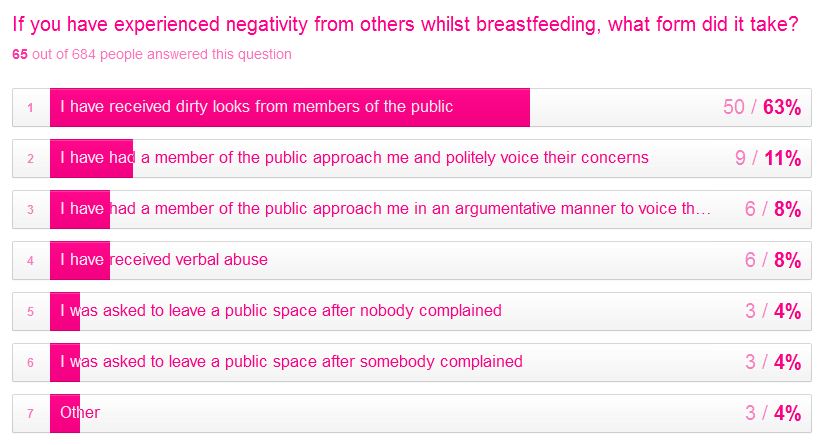
But it seems some of this paranoia is unfounded. Despite the fact that almost half of those surveyed had not attempted to breastfeed in public, perhaps more importantly only 20% of those that do embrace out-and-about feeds have experienced negativity from others. 20% is still too high in my opinion, but it’s certainly better than I expected.

bf

Perhaps the most interesting response of all however is the feedback from those brave enough to voice their personal reasons for not appreciating breastfeeding in public (12% of people surveyed). Thankfully faith was cited by only a negligible number of people, and most went onto say they would be more supportive if a woman wore a cover-up.

bf2

Far from being upset by this, I find it refreshing. I actually share a few of these concerns myself as I felt so concerned about other people’s feelings when I was breastfeeding my children. Even at home I would retreat to the bedroom if we had guests.

Was I too prudish? Unnecessarily concerned? I don’t know. But I do try to the respect the choices of everyone, and mine was to breastfeed alone, at home.

*** WIN a £50 Amazon voucher courtesy of Benenden ***

newlogo

In order to keep the debating going, Benenden are offering one lucky reader the chance to win £50 worth of Amazon vouchers. All you have to do to be in with a chance of winning, is share your experience of breastfeeding by leaving me a comment. If you’re yet to join the wonderful world of parenting you can just say what you think about the survey (HERE), or show your support (or indeed, lack of) for women who choose to breastfeed in public.

To make it fair, the winner will be picked completely at random by Rafflecopter.

Good luck guys!

a Rafflecopter giveaway


T&C’s – a.k.a – the boring bit!
  • Only 1 option is mandatory (leave me a comment) – the rest only improve your chances of winning so just complete as many as you feel like
  • UK entrants only – you must be over 18 too (sorry)
  • The winner will be contacted by email and must respond within 1 week of having been emailed (I’ll try all known avenues to contact them) or a new winner will be drawn
  • When the giveaway is closed, Rafflecopter will select the winner completely at random
  • The winners name will be published on this site

Win competitions at ThePrizeFinder.com


REVIEW: Difrax BtoB Breast Pump Review

Posted on

logo-difrax-bedrijf-1

Expressing breast milk has never been easy for me. When Dex was hospitalised with Strep B at 6 weeks I remember vividly a nurse wheeling in the Mother of all electric breast pumps (an old school Medela from what might have well as been the 17th century) and my stomach literally lurched. It looked worn, colossal and downright scary. Although I tried desperately to picture myself relaxing at home with Dexter, I just couldn’t mentally transport myself away from the cold and sterile hospital environment. Throw in a giant pinch of anxiety at seeing Dexter covered in tubes and wires, and my milk just wouldn’t come.

Dexter Strep B

This isn’t my only experience of pumping. I’ve tried various manual and electric pumps but have never got to grips with them. Without wanting you to picture me bra-less, my boobs are large and difficult to handle, and it follows that my nipples are too. I find most pumps pinch me and make me sore within minutes, and I only ever manage the most pathetic of dribbles.

However, given I’m currently combination feeding with Heidi, expressing simply HAD to work if I wanted to try and win back some of her formula feeds, and have Craig assist me as much as possible. Therefore when Difrax got in touch, I fell over myself to get involved and get my mitts on their BtoB Breast Pump. I’d seen pictures and read previous reviews of the pump and loved that it looked so radically different from all the others I’d tried. In fact, if I regress back to the school playground for a moment, it looked a little like a naughty toy. But this is actually what makes it so special.

default_15-0370-2012-5

Let’s get the negatives out the way quickly (as it’s actually an AMAZING product)

Price-wise, it’s right up there with the best of them, and there are MUCH cheaper alternatives if you’re an old pro at expressing. At £149.99, if I compare it to breast pumps that have won the affections of mums time and time again (e.g. Ameda Lactaline Double Electric Breast Pump RRP £149.99, or the Medela Swing RRP £134.99) the Difrax BtoB had some mighty big shoes to fill to warrant the price tag. Whilst I’m on the subject, I have to raise my eyebrows at any breast pump worth this price. If the goal is to get every new mother embracing the Breast is Best slogan then surely any product that helps them achieve this should be affordable.

I was also a bit put out by the fact it didn’t come with a S-baby bottle or storage cup. Luckily their bottles are exceptional (more on these later) or I’d have probably kicked up more of a fuss about this. When you’re forking out the best part of £150 you’d expect the pump to arrive through the post ready-to-go. The Difrax BtoB breast pump connector including breast milk storage container costs £3.99 and is available on the website - this might be cheap but it really should come with the pump and a S-baby bottle.

Now to tell you why you NEED one of these…

It’s the ONLY pump I’ve used that has worked for me. That makes it invaluable for me and worth five times its price if you consider I’m able to reduce formula feeds, give Craig back some vital bonding time with Heidi and make feeding a far less stressful and time-consuming experience for Heidi and I.

But its my job to tell you why it’s so good, and why it might bring you the same results where other pumps haven’t.

First up - it’s hands-free. Without going into the intricacies, you slip the breast shield (of which there are three sizes to choose from) inside your bra and pop the unit somewhere lower than your breast e.g. on the floor, on a coffee table, beside your bed etc. The unit will control the speed, pause, and control the transition from initiating to ‘let-down’. You can simply lay back and try to relax. The milk will travel from the shield, through the tube, into the valve and into your bottle.

Difrax BtoB

Why is this so great? Because it allows you to totally relax. I’m convinced that 99% of the problems women face when expressing is down the fact that the pump feels unnatural. Not so with the Difrax, in terms of comfort, I’m happy to report that it’s amazing. I can easily forget it’s on and have Craig ‘bottle-watch’ and tell me how we’re progressing. This is vital if you’re like me and find it hard to relax. Given expressing is all about re-creating a feeding environment and simulating what your baby should be doing - comfort is the only factor most new mums should consider when making a pump purchase (and this is coming from someone who really ought to know!).

The pump comes with three different sized breast shields: S, M, and L. This is brilliant given most women won’t know what size will suit them until they start expressing. By supplying all three sizes you can select the best fit for you and produce the most effective seal possible to catch the milk. The instructions are also superb - really well explained and with plenty of tips and advice for mums who are new to expressing.

What’s more, the Difrax can be battery operated to allow you freedom to express away from a wall socket. This is ideal if you are studying, watching the telly or driving. The pump comes with a little pouch for ease of carrying around the unit if you should choose to do so.

Pump1

It also claims to be silent. I’d actually be inclined to argue with this. If you pop the unit on a hard surface, it definitely isn’t! But pop it on the carpet and it whirs away silently. Given noise isn’t something that would ever put me off an electrical item, I don’t feel the need to elaborate more on this.

Cleaning is a faff - but then every pump is a faff to clean. But given we’re talking small tubes with the Difrax, it really is bit of a mission. I recommend buying a few new tubes before you get started so you’re not constantly sterilising, and have a few in reserve.

My only other slight criticism is that the tubes that come with the pump are a little short. If you’re sat on the sofa they unit will only just reach the floor. I’d have preferred a much longer tube to offer more flexibility, or perhaps a few tubes of various lengths.

As I mentioned the S-baby bottle earlier, now seems an ideal time to introduce you to them. They’re pretty impressive:

bot4

Aesthetically: Excellent. The s-shape and numerous colourways look great on your kitchen shelf.

Ergonomically: Again, excellent. They’re incredibly easy-to-hold thanks to the fact they’re long and thin.

Practically: Easy-peasy to clean with a bottle brush, measurements are well delineated, and a cinch to put together even when bleary-eyed of a morning. I haven’t experienced any leaks either. The bottle also has an unscrewable base which can be cleaned easily and filled with ice cubes of breast milk.

Anti-colic: As always I feel pretty crap advising any new mummy to ‘take my word for it’ on this - Heidi has an extreme case of colic that is yet to be solved with any bottle, medication or position.

Price: Not great. At £7.49 a bottle, we’re talking pricey. However I can say they’re pretty durable and I’d be happy to pay for the quality.

So that’s it! As always, I’ve been brutally honest, but I’m really keen to impress that this pump has revolutionised feeding times for this family. I’m desperate to see this product work in a UK market and hope they’ll be many more ‘Difrax mummies’ this time next year.

Thanks for reading my Difrax BtoB Breast Pump review, as always if you have any specific questions do leave me a comment. For more information or to buy, head on over to their Difrax’s UK website, or if you can speak Dutch, why not see what everyone else is saying over on Facebook, Twitter or G+.


Related Posts Plugin for WordPress, Blogger...