
As a travel fanatic, I have a wishlist of places I want to see. It will take me a lifetime to visit them all, and we have an ever-growing slush fund for our adventures when our children are older and we’re retired. We’re simply not content watching Michael Palin describe the sights, sounds and rich cultural tapestry of far flung places; we want to experience this ourselves. Easter Island’s myths and legends had me gripped from that start, and is definitely on our list.
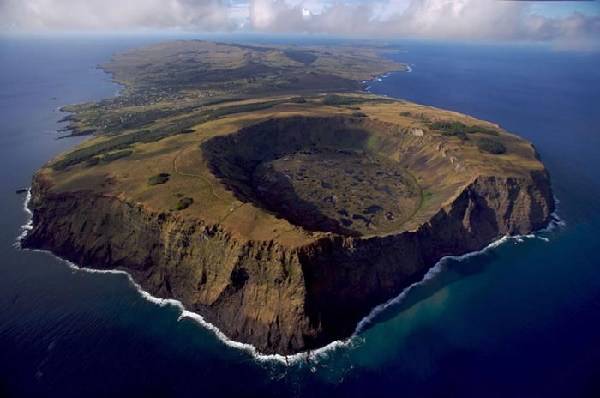
Easter Island from the air: LosApos.com
Located within the southeastern Pacific Ocean, Easter Island (Rapa Nui) is one of the most remote inhabited islands in the world. Yet this little patch of land, thousands of miles & some 5.5 hours in the air away from the nearest continent (The only regular flights are via #LANAirlines) is steeped in mythology and folklore. It’s this isolation, and indeed the near annihilation of its natives, that has left much of its history and culture shrouded in mystery.
Where did the islands first inhabitants come from? How did they carve such intricate statues & move them into position throughout the island? And what fate befell this once thriving island?
The little we know has been handed down orally by the natives, reported by ancient visitors and has likely been embellished by the imagination of the teller or the listener. Our understanding of the island flits between reality and fantasy, and the island has been the subject of more conjecture than any other place on earth.
The Rapa Nui Legend
The island’s first settler and ariki mau (supreme chief) is thought to be Hotu Matu’a who deliberately colonized the island in or around 700 to 1100 CE. Legend has it that in a dream, he was foretold that his own island (Hiva) would sink into sea and his people would perish. Having sought advise from a wise man, he sent forth seven explorers to scour the pacific ocean for a new home for his people, and it was they who miraculously discovered Easter Island - salvation offered by the sea.
Hotu Matu’a and 100 people, later arrived on the island in two double hulled canoes (like ancient day catamarans). They found an island paradise. Yam (their main food source) already existed, huge palm trees provided shelter and wood, and there was an abundance of birds and sea-life for sustenance.
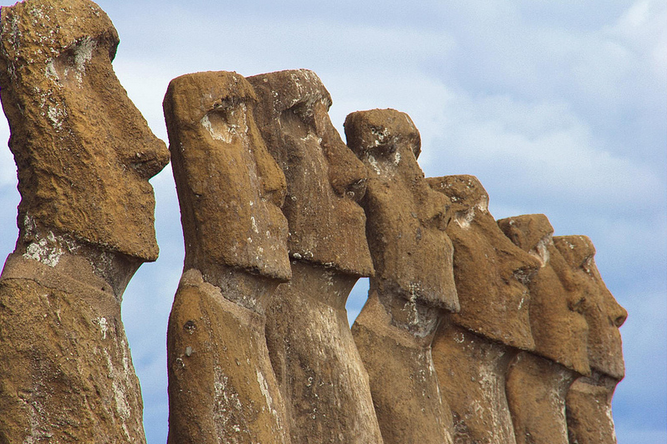 Seven Moai in Ahu Akivi; Rapa Nui: Flickr Photos Girados
The Moai
Hotu Matu’a's Polynesian colonising party built the imposing Moai that so many travelers flock to see today. It is believed these are a visual representation of the settlers belief in a symbiotic relationship with the dead. Through these offerings to their fallen ancestors, the tribesman were protected and nourished by the island, and the dead, in turn, received a better place in the spirit world. Most settlements were located on the coast and Moai were erected along the coastline, watching over their descendants in the settlements before them, with their backs toward the spirit world in the sea.
The seven Moai in Ahu Akivi are among the most iconic man-made statues in the world. It is believed they are depictions of deified ancestors, whose presence was considered a blessing over each small village. They perhaps symbolise the seven generations that inhabited the place, or maybe seven immigrant tribes, from which only one survived in order to mix with Hotu Matu’a’s people.
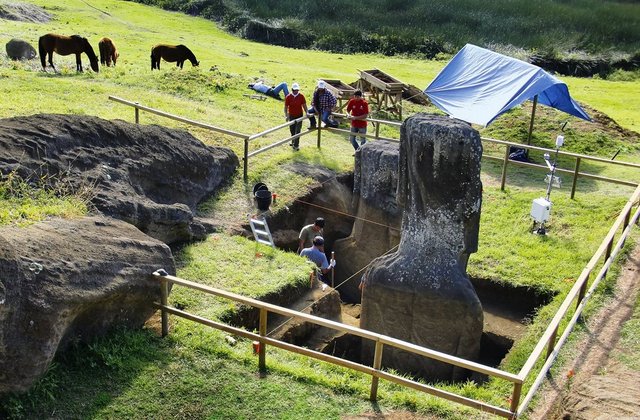 Rano Raraku: Moai Excavation: Iimaginaisladepascua.com
There are some 800 Moai at Easter Island. At first it was believed they did not have bodies, making the mystery of their existence even more intriguing. In actual fact, the heads were just disproportionately large and at the time of their discovery by the westernised world in the 1950s, the Moai had not been restored to the plinths and platforms from which they’d fallen. Rather they were buried up to their shoulders on the volcanic slopes. Now, many of the Moai have been dug out and are displayed at the Rapa Nui National Park (declared a world heritage site in 1995)
The demise of the lost world
Evidenced by the Moai themselves, early centuries on the island were full of promise and the community thrived. The island became their whole world and the islanders likely believed theirs to be the only civilisation on earth. Driftwood on its shoreline was likely regarded with awe and mystery.
However, as the population grew, so did pressures on the island’s environment. 21 species of trees and all species of land birds went extinct through a combination of overharvesting/overhunting, rat predation, and resulting climate change. The islanders struggled to make spears and seaworthy vessels to hunt, and early historians pointed fervently at ecoside and famine for the dramatic decline in population.
The islanders stood accused of having over-exploited their natural resources to build the Moai - eroding volcano banks and slashing and burning the trees to pave the way for transporting them. After all some Moai traveled some 9 miles to their final resting place on the island with their pukao (hats) alone weighing several tonnes. It was imagined the natives created a crude pulley system from felled logs, building huge roads that traversed the rugged island landscape. Food grew scarce, rumours of cannibalism followed and confidence in the old religion was lost - reflected partly in the ruins of Moai that appear to have been toppled by human hands.
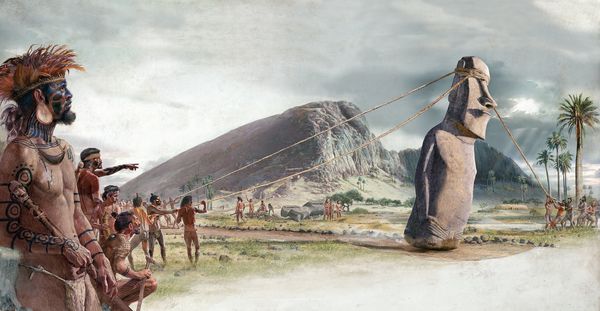 The transportation of Moai: anthropology.msu.edu
Yet the Easter Island ecoside narrative has been hotly contested. New evidence suggests that some of the Moai were moved vertically by ropes via brute strength and sheer determination. They walked that journey to their plinths by the sea - a majestic sight and feat of superior engineering well before its time. As regards the toppled Moai, the fact their noses remain intact, suggests they were gently lowered to avert their gaze rather than carelessly pushed over.
Moreover skeletal remains reveal the islanders did not die as a result of inter-community violence or famine and a new narrative was born. Historians now believe foreign explorers brought disease to the island. Much diminished as a result of tuberculosis and plague, the island was then raped by slave traders (known as blackbirding), undermining the islander’s belief systems and paving the way for the Birdman cult, and ultimately the Catholicism that still exists today.
What we can say with certainty is that Easter Island’s population did plummet. By the time of European arrival in 1722, the island’s population had dropped to 2,000–3,000 from approximately 15,000 just a century earlier. Those European diseases and Peruvian slave raiding in the 1860s further reduced this number to just 111 inhabitants in 1877.
The Tangata Manu (“Birdman” Cult)
As disaster beset the island a new religious ideology grew in stature. The island was a wasteland, the eroded soil barely producing enough food for the meager population to survive. The islanders maintained that, although the ancestors still provided for their descendants, the medium through which the living could contact the dead was no longer statues, but human beings (leaders) chosen through a grueling competition.
And so, 1000ft above sea level on the rim of the crater Rano Kau, the ceremonial village of Orongo (built to worship the god of fertility, Makemake) became the site of the annual Birdman competition.
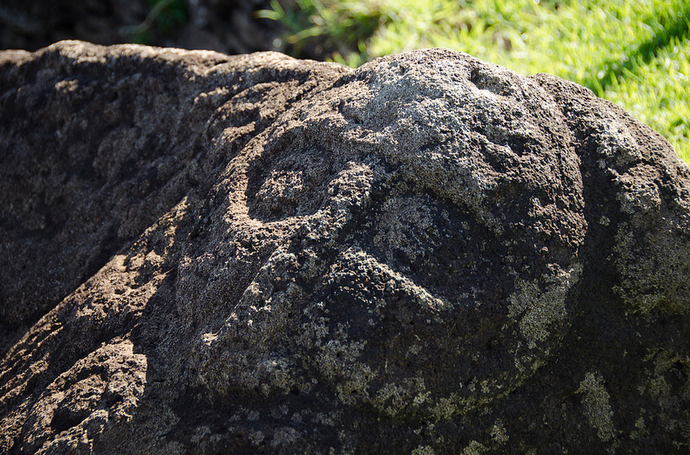 Makemake: Flickr Ryan Tomko
Contestants, all men of importance on the island, were revealed in dreams by ivi-attuas or prophets. Each contestant would then appoint a hopu (man of lesser status) who would compete in their honour. Leadership of the island was determined by the first hopu who could scale down the vertical slopes, swim out to one of three small islets in shark-infested waters, and bring back the egg of the nesting sooty tern unbroken. The one who did this successfully elevated their sponsor to Birdman of the year and was bestowed with special honors and privileges.
These competitions for Bird Man started around 1760, after the arrival of the first Europeans, and ended in 1878, with the construction of the first church by Roman Catholic missionaries who formally arrived in 1864.
A modern day paradise for today’s explorers
A firm favourite for photographers, the Moai can be visited for free and are mostly found along the coastline of the island. Each village typically had an ahu (a stone tablet on which the statues were placed) and several Moai.
Otherwise there are the volcanic craters of Rano Kau and Rano Raraku, the quarry of the latter being where most of the Moai were carved out of tuff (a compounded volcanic ash). Here, you can see various stages of the carving, as well as scattered partially-finished figures.
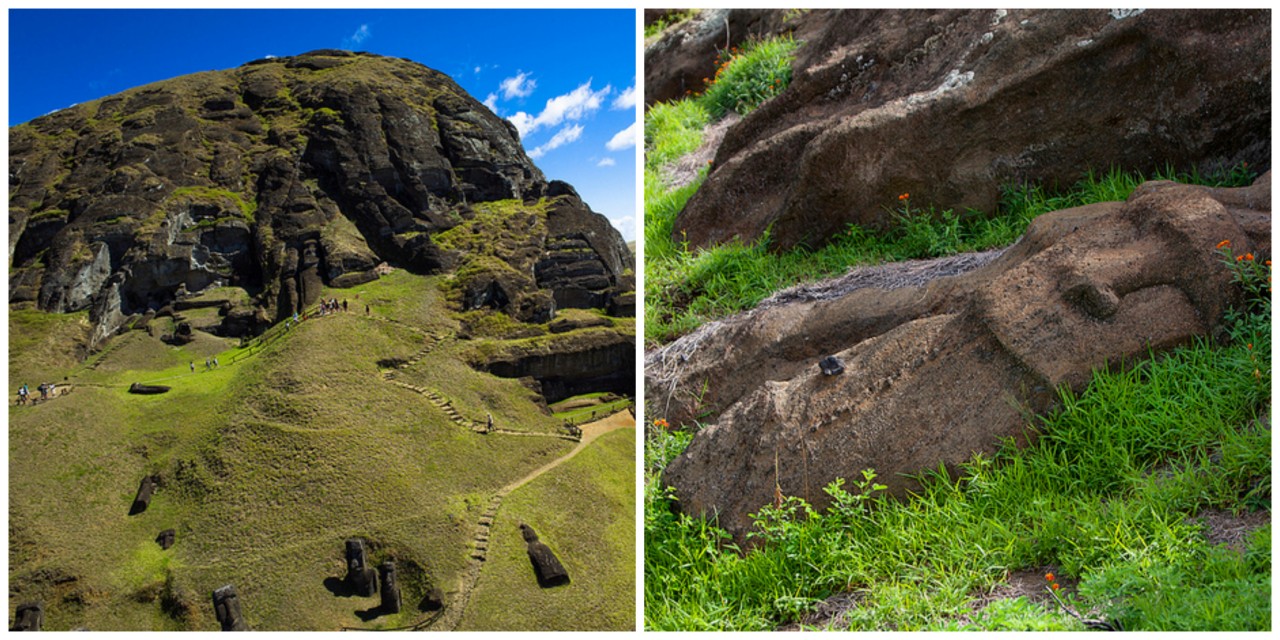
There’s also an extensive cave system on the island. As well as official caves, you’ll also find several near Ana Kakenga off the beaten track. The most frequently visited of the caves is the ominously named Ana Kai Tangata (Eat Me Cave) which features sophisticated rock art on its ceiling and walls.
For archaeology and ecology buffs there’s also rich evidence of the Rapa Nui stewardship of the island; mini walls gardens and shallow caves provided micro-climates for crop-growing, and ancient water trenches were discovered earlier this century - yet more evidence of the creativity of its people.
Moreover, during the first two weeks of February there’s also the Tapati Rapa Nui festival which sees the island separated into two teams (each part representing the ancient races of the island) and competing for the honour of the island.
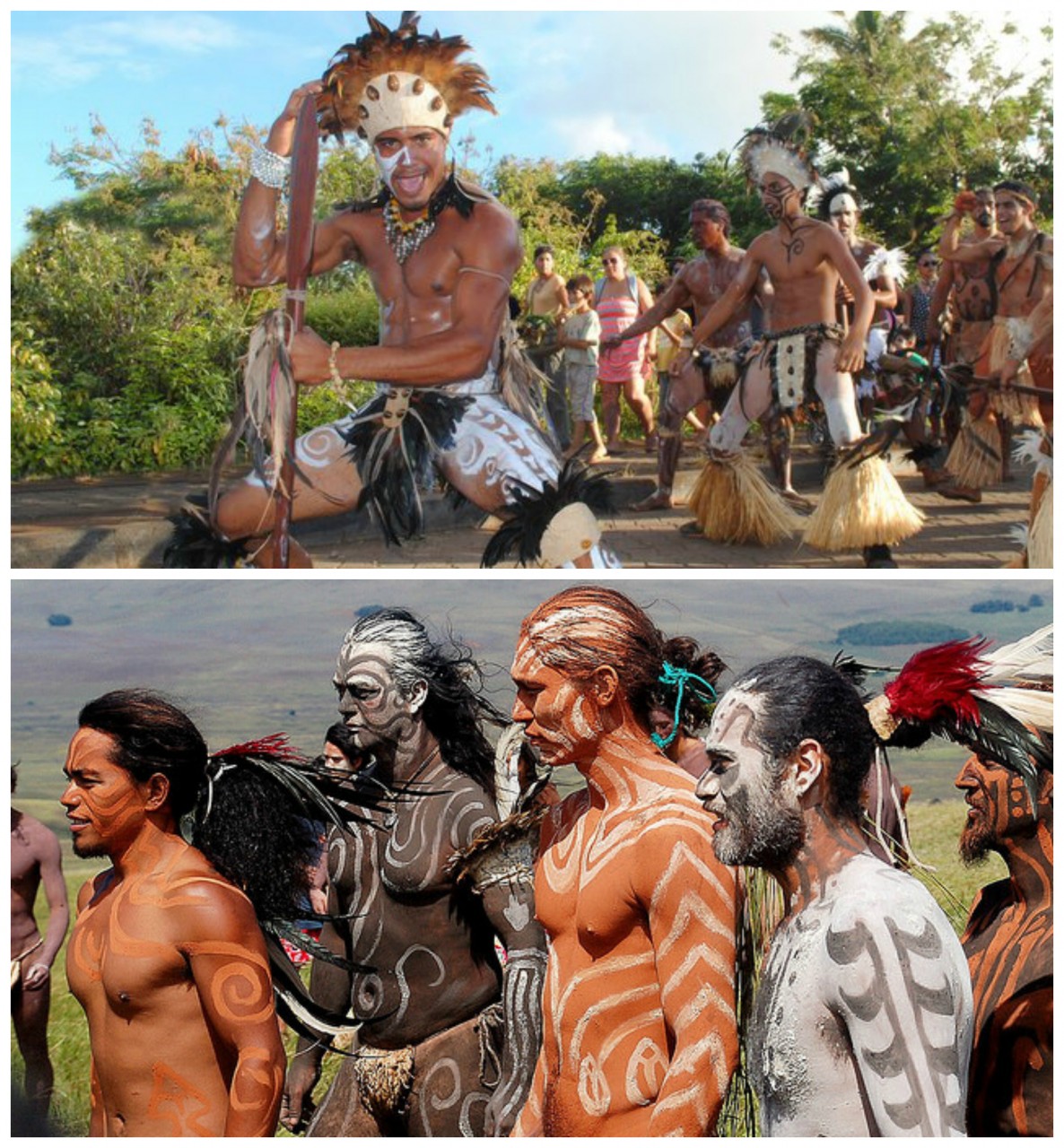 Tapati Rapa Nui Competition: Iimaginaisladepascua.com
Finally, for the less intrepid, there’s an imposing and stunning coastline.
Whether you enjoy hiking, biking, surfing, diving, horseback rides or simply relaxing, you’ll be surrounded by an aura of haunting sadness and heartbreak, yet people who remain wonderfully inspiring and optimistic about their islands future. Although, there’s just one little town to welcome the 85,000 tourists each year, and much of the resources they need arrives by air, they maintain they could survive alone on the island once again. It’s a true bucket list experience.

